
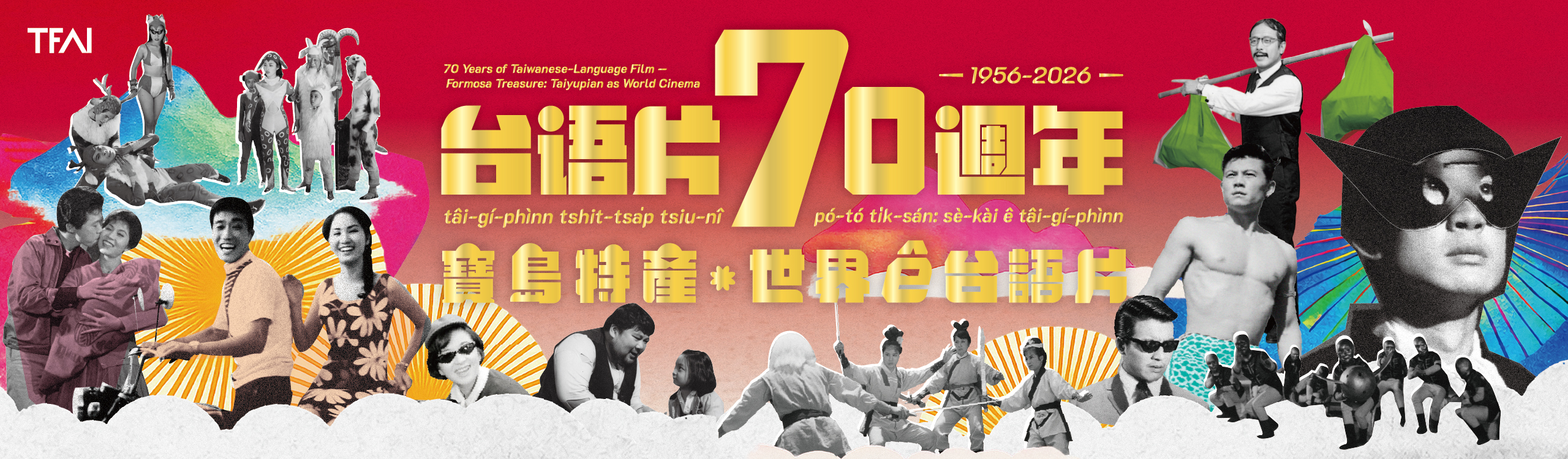
70 Years of Taiwanese-Language Film Formosa Treasure: Taiyupian as World Cinema
As commercial films made in Taiwan and voiced in the Taiwanese language, Taiyupian can be considered an “endemic species of Taiwan” in world cinema history, transcending time and space to become precious film and audiovisual heritage. Following the release of Xue Pinggui and Wang Baochuan in 1956, the first Taiyupian shot and released on 35mm film, a golden age of Taiwanese-language cinema began. This year (2026), Taiyupian officially celebrates its 70th anniversary. To mark this milestone, the Taiwan Film and Audiovisual Institute (TFAI) has launched a year-long commemorative program entitled “Formosa Treasure: Taiyupian as World Cinema” (Pó-tó Ti̍k-sán: Sè-kài ê Tâi-gí-phìnn). The digitally restored Taiwanese-language classic The Wandering of Three Siblings (1963), restored by TFAI, was screened at SOAS University of London on June 12. More international screening dates will be announced soon.
Beginning in March, the series features film screenings, interactive exhibitions, artifact showcases, and a wide range of public programs, inviting audiences to rediscover the origins of Taiwanese cinema.
The year-long program unfolds through four core themes:
Contemporary Resonance
* Special Program (March): Salute to the Pioneers of Taiwanese-Language Cinema (Taiyupian): Ho Chi-ming and Huaxing Movie Studio
* Themed Screening Series (April–August): Taiyupian Relativity, a monthly selection of films exploring the affinities and divergences between Taiyupian and world cinema, offering a view of the world through a Taiwanese lens.
* September Special Program:
Zero-Hour Visions: The Moving Worlds of Taiyupian, accompanied by the launch of exclusive anniversary merchandise.
* Digital Restoration Premieres: Zhang Di Seeks A-Zu (1969), Good Neighbors (1962), and Love Never Ceases (1962).
* Institutional Collaborations: Joint programs with Fuzhong 15, Image Museum of Hsinchu City, Hsin Kang Foundation of Culture and Education, PTS Taigi TV Station, and other partner organizations.
Textual Expeditions
* Publication of a series of Taiyupian screenplays and Blu-ray releases.
* Collaborations with theater companies on staged performances and script-reading events.
Lost Film Histories
* Independent research on surviving fragments of Taiyupian.
* A research symposium scheduled for October.
World Memories
* Revisiting and retracing the history of Taiyupian through filmmakers’ oral histories, online curatorial projects, and international outreach.
According to TFAI’s research, approximately 1,200 films in Taiwan’s cinematic history can be categorized as Taiyupian. However, only about 200 titles remain in TFAI’s collection; the rest survive only in written records or fragmentary footage. Since launching preservation and research initiatives in 1990, TFAI has continuously devoted itself to collecting film prints, artifacts, and oral histories, while expanding its work into film research, digital restoration, and international promotion. Taiyupian works, together with their screenplays, posters, and related artifacts, have accompanied TFAI throughout its development and remain among its most treasured archival holdings.
Taiyupian were once dismissed as crude productions or overly melodramatic. Yet, as a cinematic form fundamentally rooted in language, they embody a distinctive cultural identity. Taiwan film historian YEH Lung-yen once observed:“Taiyupian possess both deep local roots and strong Japanese influences, while also absorbing cultural elements from the United States and Europe. Their remarkable diversity of genres and subjects demonstrates Taiwan’s international outlook and maritime character through continual learning and creative adaptation.” Today, viewing Taiyupian from the perspective of world cinema reflects a shift grounded in TFAI’s research over the past decade. The title “Formosa Treasure: Taiyupian as World Cinema” likens Taiyupian to a distinctive flavor nurtured by the island of Formosa. It elevates the perspective from the local to the global, positioning Taiyupian not only as an irreplaceable cultural expression of Taiwan, but also as an essential coordinate in global film history. Rich in diversity and cultural significance, Taiyupian deserves recognition not merely as Taiwanese-language films of Taiwan, but as Taiwanese-language films that belong to the world.
More information about the anniversary program will be announced on the TFAI official website and social media channels.