
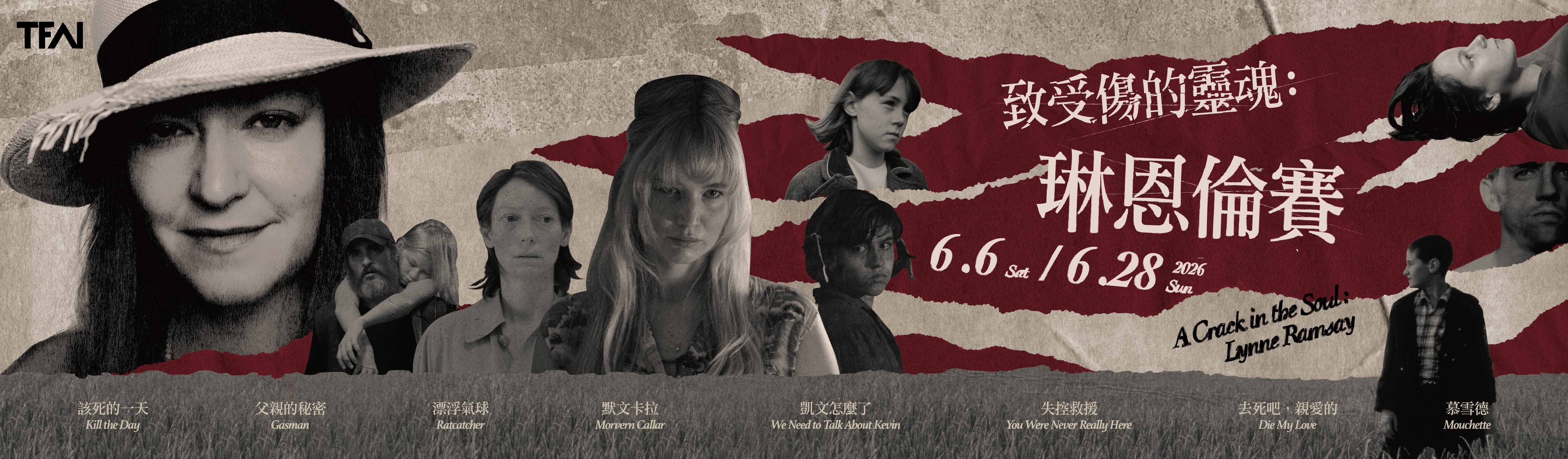
A Crack in the Soul: Lynne Ramsay
"There is a crack, a crack in everything. That's how the light gets in."
— "Anthem" by Leonard Cohen
The films of British director Lynne Ramsay are built around fractured lives and the lingering aftershocks of trauma. Rather than confronting catastrophe in its raw immediacy, she turns away from the moment of impact and works from what remains, allowing memory to seep back into the present through audiovisual fragments. Her cinema often unfolds through a sensorial landscape, rendering grief and emotional disorientation not only as a psychological state, but also lived bodily experience.
She does not attempt to heal or resolve trauma in any conventional sense, but instead holds space for it. What emerges is a quiet act of repair that never fully closes the wound, where faint traces of light continue to leak through its fissures.
Against the Frame: The Resilience of a Maverick
Ramsay grew up in a working-class family in Glasgow, Scotland, and showed an early interest in visual art. She studied still photography at Napier College in Edinburgh, and later applied to the National Film and Television School near London. At film school, she initially focused on cinematography. However, as a small-framed woman entering a male-dominated field, she was not taken seriously by some of her teachers and peers. Refusing to accept these limitations, she pushed to graduate as a director instead. Her graduation film Small Deaths (1996) attracted immediate attention, screening at Cannes and winning the Jury Prize presented by the Jury President Francis Ford Coppola.
After several award-winning short films, her first feature Ratcatcher (1999) premiered in Cannes' Un Certain Regard section and was widely recognized as a striking debut. All of her subsequent features would also premiere at Cannes. Despite early recognition, Ramsay has remained a filmmaker of relatively sparse output in her career. Conflict has often shadowed her projects. Her years of work on the adaptation of the best-seller The Lovely Bones were stripped away when financiers deemed her vision insufficiently commercial, reassigning the project to Peter Jackson. Her uncompromising stance was further evident when she left Jane Got a Gun on the eve of production, refusing to alter the script's original ending. Though this cemented her reputation as "difficult," it also reflects her refusal to let her authorial voice be silenced.
Ramsay resists the label of "female director," yet acknowledges how her Glaswegian accent, working-class roots, and directness often clash with industry expectations in both London and Hollywood. In one interview, she pointed to the double standard: a man's intransigence is often read as artistic integrity or even a sign of genius, while a woman's conviction is dismissed as mere "difficulty."
The Poetics of Trauma: In the Realm of the Senses
Despite these obstacles, Ramsay's singular audiovisual language continues to attract collaborators. While her work draws from British social realism, she inverts the focus, looking inward toward the characters' internal scars. Her characters often drift into a state of near-silence, as if language itself can no longer contain the weight of their trauma.
For this reason, she abandons explanatory dialogue and psychological exposition, instead working through what scholars have described as "haptic visuality"—a cinema that engages the body as much as the eye. Color, sound, texture, breath, and sensorial rhythm become primary expressive elements, through which she constructs a tension where tenderness and violence coexist without resolution.
Her films are frequently described as poetic, though not in any decorative sense. Ramsay has long regarded Bresson's Notes on the Cinematograph as foundational, absorbing his ascetic approach to actors' physical gesture, where the smallest movement of a hand can carry immense emotional weight. She also adopts his principle of disjunction between sound and image, creating associative gaps that activate the viewer's imagination: a motionless face accompanied by disquieting soundscapes, or a sudden silence or musical shift within moments of intense visual charge, generating unease and suspended meaning.
This program showcases all five of Ramsay's feature films alongside two early shorts, paired with Bresson's Mouchette and a special program on her Scottish predecessor Bill Douglas. Together, these works form a constellation where coming-of-age, memory, and sensation intersect, revealing how Ramsay transcends verbal storytelling to explore the poetics of trauma. Her films do not seek to mend the broken; instead, she enters the depths of their wounds, listening to them against the deafening silence, and finding the light that still flickers within the fractured souls.
Corrections and Updates Notice
[ON Program Catalog] Updated on May 20th, 2026
• p.19 The year of release for Ratcatcher is 1999.
[Film Rating Revision] Updated on June 5th, 2026
• Kill the Day + Morvern Callar is rated PG15
• We Need to Talk About Kevin is rated PG15
• Mouchette is rated PG12