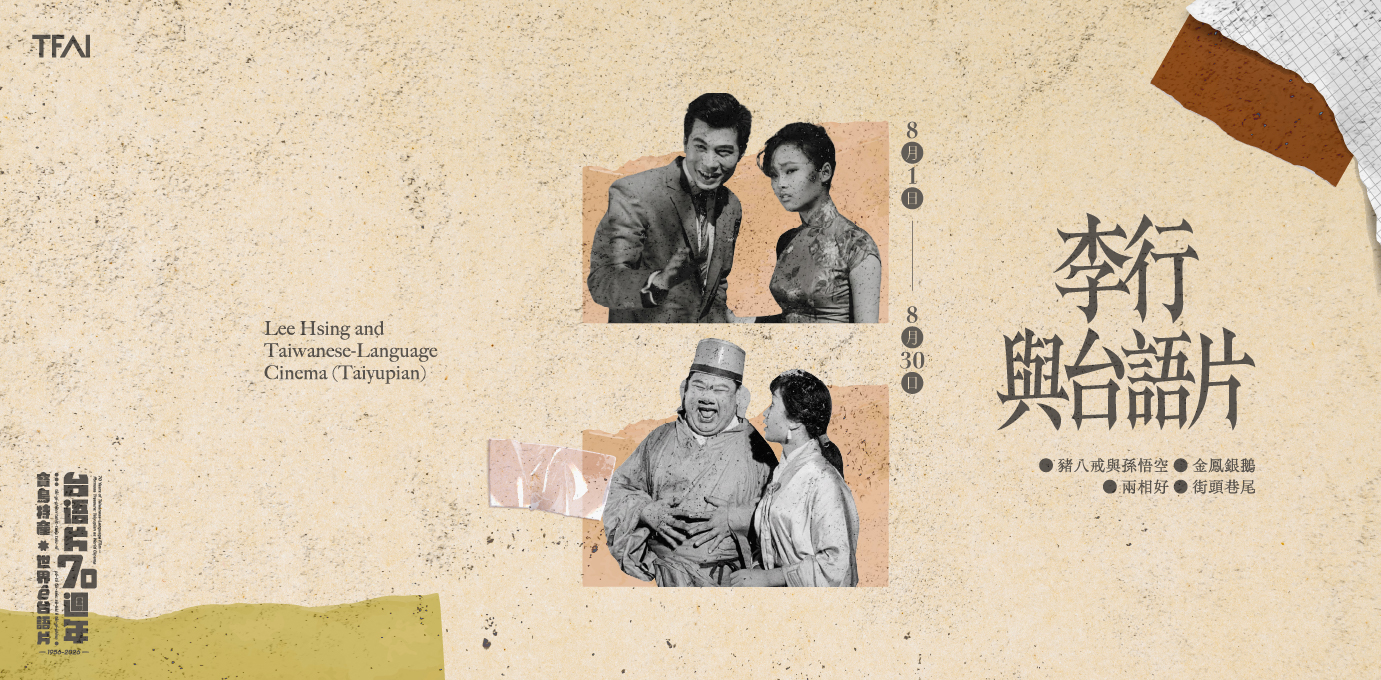
Lee Hsing and Taiwanese-Language Cinema (Taiyupian)
Lee Hsing is most often remembered for his achievements in Mandarin-language cinema. In the 1950s, Taiyupian, the Taiwanese-language cinema, flourished in Taiwan, forming a highly dynamic field of film production. Working within this environment, Lee Hsing developed his craft through practice, gradually shaping his methods and artistic vision.
Between 1958 and 1963, he directed 12 Taiyupian features. Seen today, these films were not merely apprentice works before his Mandarin-language period. Rather, they reveal how postwar Taiwanese cinema took shape across different languages, genres, and cultural influences. In this sense, Taiyupian was not a closed or purely local form, but an open production space marked by continual borrowing and hybridization.
This program presents four films as four paths into the formation of Lee Hsing's early film practice. Two Friends and The Royal Society show his keen grasp of popular performance and paired-character structures: comic duos, mistaken identities, cross-dressing, and genre borrowing give these films an energy quite different from his later Mandarin-language works. Good Neighbors is often regarded as a key turning point in his move toward Mandarin cinema and is frequently discussed in terms of ethnic reconciliation. Yet what makes it especially interesting is the way Lee turns everyday negotiations over family life, marriage, work, and language into the very rhythm of comedy.
The only Mandarin-language title in this selection, Our Neighbor, does not mark a complete break from Lee Hsing's Taiyupian period. Rather, it can be seen as an important attempt to redirect the plebeian perspective and practical experience he had accumulated in Taiyupian toward an urban realist style. Through these four works, we can see that the director later canonized as a major figure in Mandarin-language cinema was also deeply shaped by Taiyupian as a site of experimentation, negotiation, and formation.