
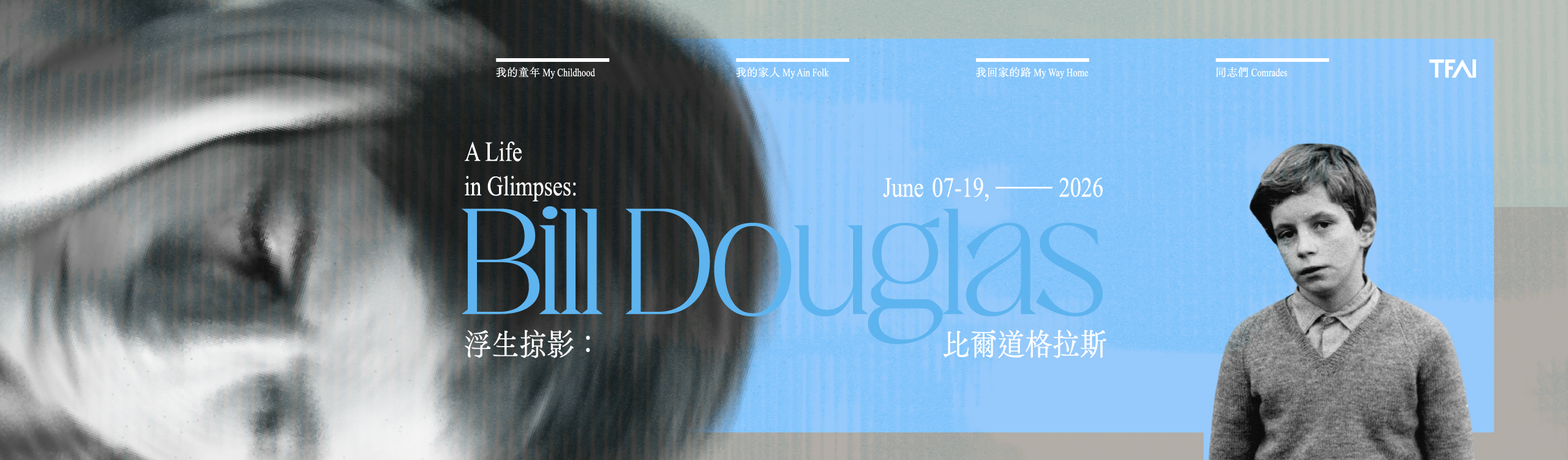
A Life in Glimpses: Bill Douglas
"If you care about filmmaking, you should watch Bill Douglas. It's just the same as Stanley Kubrick or Andrei Tarkovsky... it's up there with Tarkovsky." — Lynne Ramsay
Bill Douglas (1934–1991) was born in the mining village of Newcraighall in Scotland and came of age under the shadow of abject poverty. Born out of wedlock and raised by his grandmother in a broken home, he developed an early interest in art, deemed by his family as impractical. His path shifted during military service, where he met his lifelong friend Peter Jewell, whose influence led him to pursue performative art in London.
He trained as an actor in Theatre Workshop and acted in television, but remained drawn to cinema. In 1969 he entered the London Film School, turning his childhood memories into a screenplay titled Jamie. When shown to Lindsay Anderson, Anderson immediately recognized its autobiographical nature and urged him to embrace it fully. Eventually, with support from the British Film Institute, Douglas completed his coming-of-age trilogy on a minimal budget, becoming the first Scottish filmmaker to screen at the Venice and Berlin Film Festivals. Defined by austere black-and-white imagery, static compositions, and bleak but resonant soundscapes, the trilogy captures both the cruelty and the tenderness of childhood, hailed by the Head of Production of BFI as pure visual storytelling.
Working under economic constraints and refusing to compromise his artistic vision, Douglas completed only four feature films in his life. He called cinema a "palace of dreams" and "global refuge" for the soul. In later years he became fascinated with pre-cinematic devices such as the magic lantern, and the collection he built with Peter Jewell later formed the basis of a museum in his name. Writer Raymond Carver, quoting V.S. Pritchett, once defined short stories as "something glimpsed from the corner of the eye." Douglas's cinema works similarly: it captures fleeting fragments of human existence within desolate landscapes, like the transient glow of a magic lantern in the dark—ephemeral yet leaving an indelible imprint on memory.
[Film Rating Revision] Updated on June 5th, 2026
• Comrades is rated PG12