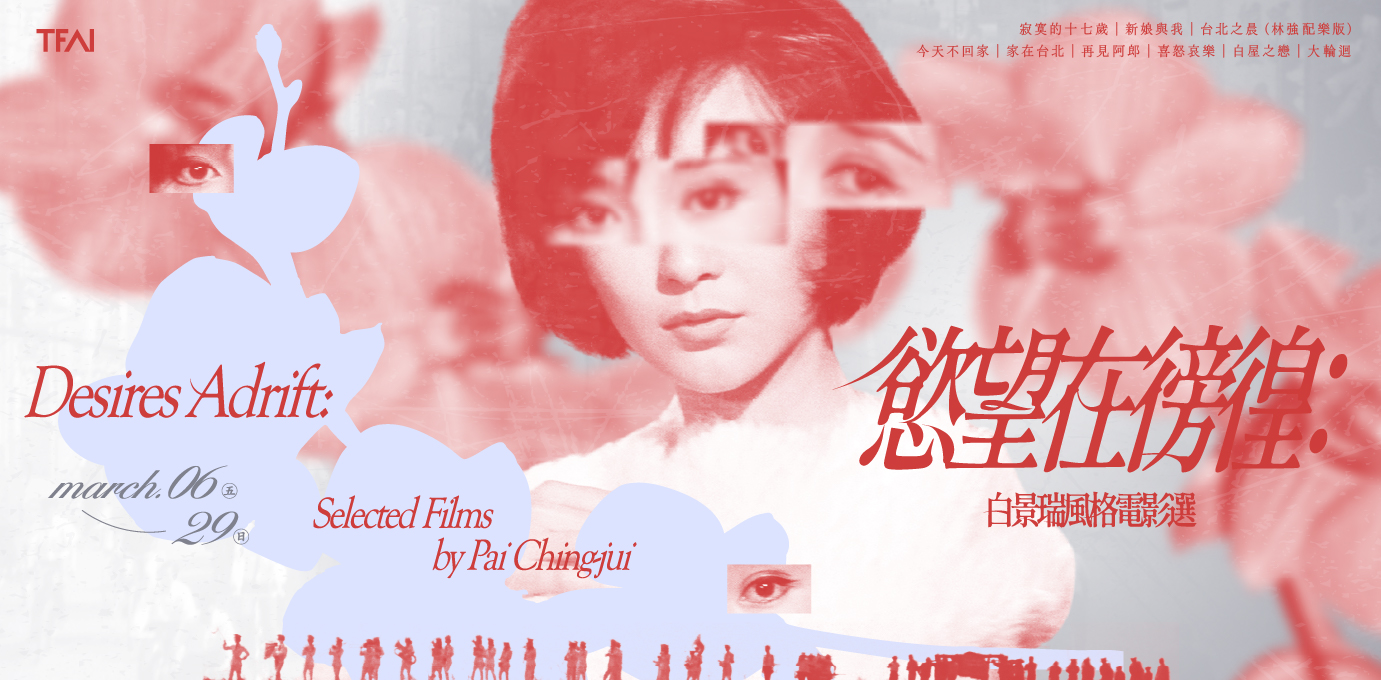

Desires Adrift: Selected Films by Pai Ching-jui
Desires Adrift: Selected Films by Pai Ching-jui
Text by Hung Hung
Pai Ching-jui and Lee Hsing were born just a year apart. Both came to Taiwan as students in 1949 and met in the drama club at university. After working in parallel as film and theatre reporters for the Independence Evening Post, they joined the Central Motion Picture Corporation (CMPC) to shape "Healthy Realism," a state-backed style meant to be modern, socially grounded, and morally instructive. They later co-founded Grand International (Da Zhong) Motion Picture Company and went on to lead the boom in Chiung Yao literary romance adaptations.
Their styles, however, could not be more different. Lee, who started in Taiwanese-language cinema (Taiyupian), focused on the clash between emotion and moral duty. Pai, by contrast, studied in Italy. He blended Neorealism’s social gaze with a bold visual sensibility and an extroverted passion. He was later dubbed an "unhealthy" realist; and in the early 1980s his darker, more socially driven films also intersected with the wave of "Taiwanese Black Movies."
Pai’s first project after returning to Taiwan, A Morning in Taipei, was cut short. The surviving footage nonetheless recalls the 1920s European "city symphony" films, built from urban rhythms and graphic montage. His first independent feature, Lonely Seventeen (sharing a title with a story by Pai Hsien-yung), turns adolescent desire into something tense and distorted. Pai shifts the protagonist into a schoolgirl, tracing how romantic fantasy—kept under pressure—slides into obsession and breakdown.
His satirical streak comes through most clearly in the comedies that followed. Working with cinematographer Lin Tsan-ting, Pai favors showy framing: layered foregrounds, split compositions, push-pull camera moves, and even silent-era speed effects. Sometimes the camera seems to perform louder than the actors. This taste for visual display becomes outright virtuosity in romances like Love in a Cabin. The Bride and I follows the detours from courtship to marriage, while Accidental Trio crosscuts three middle-class households—newlyweds, a three-generation family, and a girl lost in daydreams—each unsettled by desires that have nowhere to go.
Goodbye Darling, adapted from Chen Ying-zhen’s The General’s Clan, replaces literary idealism with harsh emotional combat. By adding the volatile A-lang as a driving force, Pai explores a struggle fueled by raw desire.The film’s striking eroticism and its iconic final sequence perfectly encapsulate Pai’s career-long fascination with human desire under constraint. His visually daring body of work remains essential for rediscovery and reassessment.