
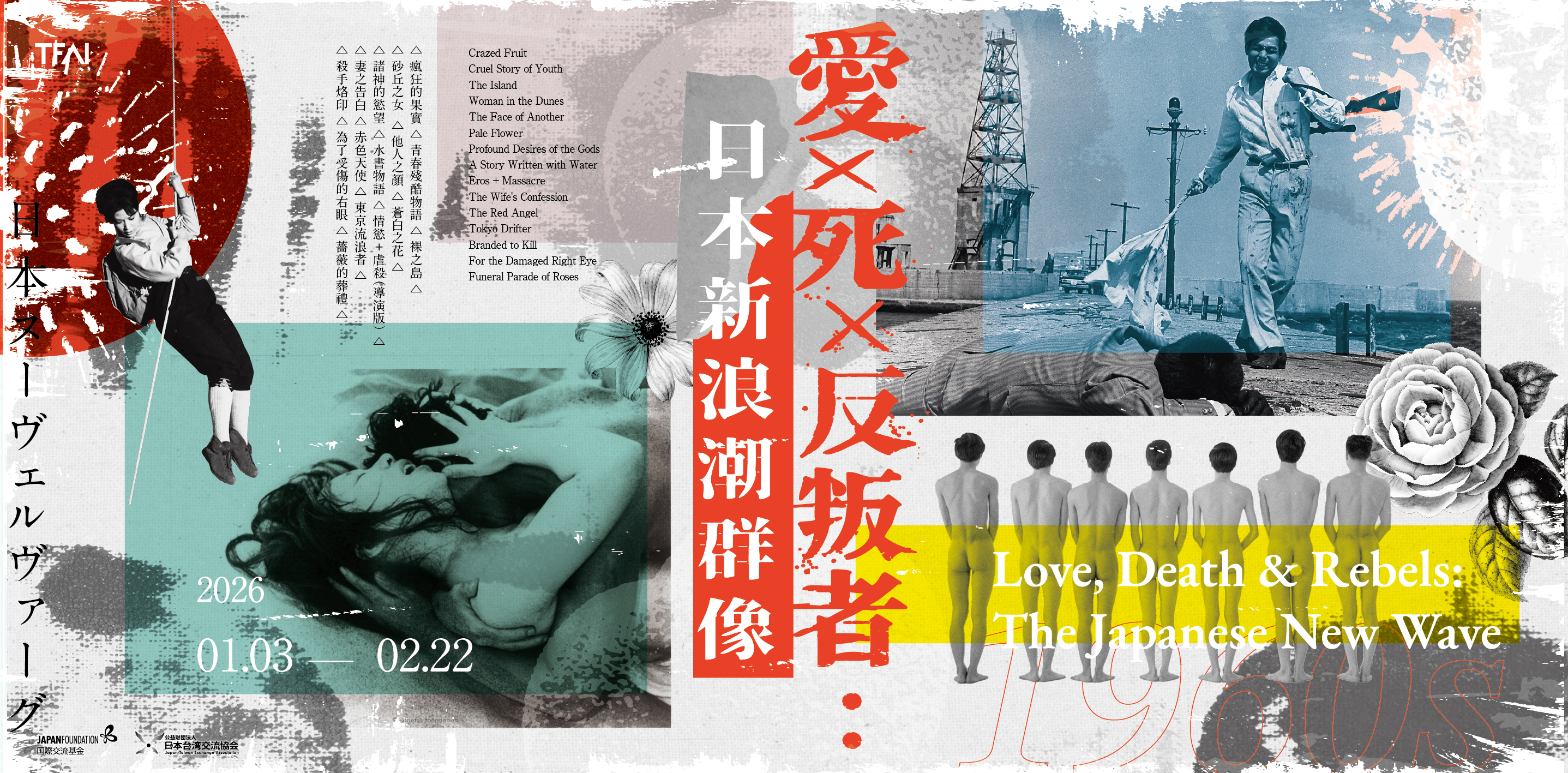
Sex did not equate to desire, nor did violence necessarily represent crime. In postwar Japan, a wave of emerging filmmakers burst onto the cinematic scene, channeling their discontent with society through radical and provocative imagery. Love, Death & Rebels: The Japanese New Wave, the first thematic program of 2026 presented by the Taiwan Film and Audiovisual Institute (TFAI), brings together 15 seminal works of Japanese New Wave in collaboration with the Japan Foundation and the Japan-Taiwan Exchange Association. Running from January to February 2026 at TFAI, the program invites audiences to confront depictions of death, bloodshed, and sexualityand to witness how cinema became a forceful act of social intervention.
Following World War II, Japan experienced rapid economic recovery. Yet as the nation moved toward prosperity and modernization in the late 1950s, society was simultaneously engulfed in fierce protests against the US–Japan Security Treaty. Young people, still haunted by the trauma of defeat, struggled with uncertainty about the future, even as the government boldly proclaimed that Japan had entered a “post-postwar” era. Against this turbulent backdrop, a new generation of filmmakers transformed their inner conflicts and simmering resentment into the explosive cinematic movement known as the Japanese New Wave. Through films centered on desire and death, they mounted uncompromising critiques of authority, power, and rigid social structures.
The program opens with Crazed Fruit (1956), adapted from a novel by ISHIHARA Shintaro. Depicting young men and women racing speedboats and indulging in reckless pleasures, the film was instrumental in establishing the iconic image of Japan’s rebellious “Sun Tribe” subculture. Several years later, OSHIMA Nagisa continued this exploration of youthful defiance in Cruel Story of Youth (1960), exposing the illusion of social harmony through a story of sexual assault and blackmail involving a high school girl.
Renowned for his focus on “the lower strata of society and the lower part of the human body,” IMAMURA Shohei drew inspiration from Japanese folklore in Profound Desires of the Gods (1968), depicting the incestuous desires of an island’s indigenous inhabitants and the human conflicts ignited by modern development. Other powerful modern allegories featured include The Face of Another (1966), starring the late veteran actor NAKADAI Tatsuya, SHINDO Kaneto’s The Naked Island (1960), and TESHIGAHARA Hiroshi’s Oscar-nominated Woman in the Dunes (1964). Together, these works reflect the profound sense of alienation and helplessness experienced by individuals engulfed by a rapidly modernizing society.
Meanwhile, master MASUMURA Yasuzō explored female desire and the boundaries between life and death through sexuality in A Wife Confesses (1961) and Red Angel (1966); MATSUMOTO Toshio boldly portrays Tokyo’s underground gay scene of the 1960s in Funeral Parade of Roses (1969); and YOSHIDA Yoshishige probed Oedipal themes of incest in A Story Written with Water (1965) and revisited taboo polyamorous relationships of the Taishō era in Eros + Massacre (1969). Together, these films announce the unraveling of social norms and moral certainties.
Japanese film historian YOMOTA Inuhiko points out that Japanese New Wave directors “saw through the illusions of postwar society and critiqued reality with irony… often confronting immense difficulties, yet ultimately introducing entirely new themes, narrative structures, and cinematic languages to Japanese cinema.” Love, Death & Rebels: The Japanese New Wave presents these 15 fiercely powerful classics in rare versions, including 4K digital restorations and archival film prints. Returning to the big screen at TFAI in January and February 2026, these films demonstrate that, in today’s still-turbulent world, their audiovisual impact remains as startling and resonant as ever.
Love, Death & Rebels: The Japanese New Wave
Date: 3 January - 22 February 2026
Venue: Taiwan Film and Audiovisual Institute
Ticketing Information: https://tfaitw.pse.is/8g9zhq