

節目簡介
國影電影編號:M2026_03_03
放映規格:DCP
級別:普遍級
片長:20分鐘+104分鐘
發音:無對白+華語
字幕:無字+中英
台北之晨 (林強配樂版) A Morning in Taipei
白景瑞 PAI Ching-jui|台灣 Taiwan|1964|DCP |B&W|20min
2018 台灣國際紀錄片影展 Taiwan International Documentary Festival
2020 台北電影節 Taipei FF
從朦朧黎明到晨曦初現,影片捕捉台北各行各業的生命脈動。送報生、工廠勞工與中產家庭的晨間律動交織,在快速剪輯下,展現出勃發的生命氣息,以及動感的都會節奏,整座城市彷彿在鏡頭前甦醒過來。
白景瑞借鏡歐洲1920年代「城市交響曲」電影,以「仿紀錄片」手法記錄1960年代的台北市景。看似紀實,實則經過精密調度。初剪原擬保留現場環境音,只是在「健康寫實」主流的年代,這批極具前衛性的毛片未獲認可,計畫因而中止,原始拷貝也隨之散佚。僅存剪接後的工作帶,兩度瀕臨銷毀,2008年才首度公映,成為他赴義大利習得現代影像語法的珍貴見證。本次放映2019年由林強全新配樂版本。
From misty dawn to sunrise, the film captures the life pulses of Taipei's diverse trades. Through rapid editing, the morning rhythms of laborers and middle-class families reveal a vibrant life force and dynamic urban tempo. Shot as a carefully staged "mock-documentary," the project was halted when its experiment did not fit the era's dominant"Healthy Realism," and the original print was lost. Only two edited workprint reels survived—nearly destroyed twice—before being rediscovered decades later as a striking early proof of Pai Ching-jui's post-Italy aesthetic. This screening features a new score by Lim Giong (2019).
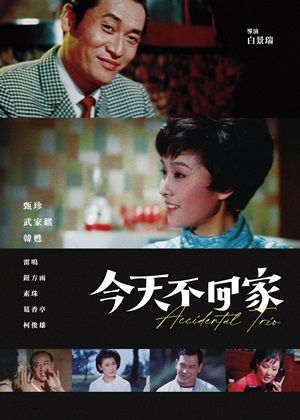
今天不回家 Accidental Trio
白景瑞 PAI Ching-jui|台灣 Taiwan|1969|DCP |Color|104min
1969 亞洲影展最佳編劇 Best Screenplay, Asia-Pacific FF
2025 高雄電影節 Kaohsiung FF
2025 聖地牙哥亞洲電影節 San Diego Asian FF
在台北一棟公寓的上中下三層,今晚各有一人不回家。重考生張珍珍被父親禁足多日後負氣出走;頂客族汪華成與妻子吻別,轉身奔向自美返台的前女友;四孩鬧翻天的洪敬德則一早宣告加班,借工作之名逃離。漫漫長夜裡,三條路線時而交會,天亮前他們都得回答同一個問題:回家,還是不回?
白景瑞以多線敘事開發獨具一格的社會寫實喜劇。人物穿梭公寓樓梯、高爾夫球場、西餐廳等現代場景,拼湊出專屬中產階級的成人樂園。在林贊庭華麗多變的運鏡下,透過複雜的景深層次與繁複的陳設構圖建立深層空間感,將人物內心蠢蠢欲動的越界慾望轉化為視覺奇觀,觀眾彷彿化身窺視者,在笑聲裡體會到劇中人的苦悶與不安。
Tonight in a Taipei apartment building, one person in each of three families chooses not to go home. A grounded exam retaker storms out, a DINK husband fakes a business trip to meet his ex-girlfriend, and an exhausted father claims overtime to escape his noisy household. Their routes occasionally intersect through the long night until dawn forces a decision. Pai Ching-jui turns this premise into a stylish social-realist comedy through modern city spaces, split framing, masking, accelerated montage, and a theme song that captures a new middle-class urban mood.